

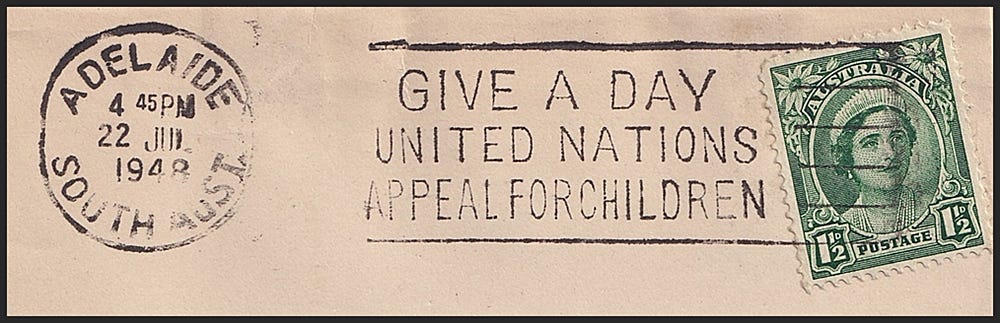
The Australian postal slogan GIVE A DAY UNITED NATIONS APPEAL FOR CHILDREN was used nationally from Monday, 19 July to Saturday, 31 July 1948. It promoted Australia’s participation in the United Nations Appeal for Children, a worldwide voluntary fundraising campaign supporting the work of the United Nations International Children’s Emergency Fund (UNICEF). Created in the aftermath of the Second World War, UNICEF sought to provide food, medical assistance, and other practical support to children suffering from the consequences of conflict, displacement, and deprivation. Through its appearance on the mail, this slogan sought to remind every Australian of their role in a wider international humanitarian effort.
The appeal emerged from the continuing humanitarian crisis that followed the war. The United Nations Relief and Rehabilitation Administration (UNRRA), established in 1943 by the Allied nations then known collectively as the United Nations to assist countries devastated by conflict, had provided food, clothing, medical supplies, and other relief to millions of displaced people. As UNRRA approached the end of its temporary mandate, many children in Europe and Asia remained in desperate need. Following the establishment of the United Nations as an international organisation in 1945, it created the United Nations International Children’s Emergency Fund (UNICEF) in December 1946 to carry on this work. However, the new organisation did not immediately have the funds, administrative machinery, or supply network needed to operate on the broader scale the crisis demanded. It was therefore not until 1948, with the United Nations Appeal for Children, that UNICEF was able to launch its first worldwide voluntary fundraising campaign, enabling it to expand its humanitarian work beyond the resources initially available to it.
The idea behind the appeal originated with Åke Anker Ording, a tall, idealistic Norwegian United Nations secretariat member who adapted a Norwegian fundraising tradition in which people donated the equivalent of a day’s work to help those facing hardship. The leap year of 1948 provided the inspiration for a powerful symbol: if everyone gave the value of their additional day’s earnings, that collective contribution could help save the lives of children in need. From this simple idea emerged the “Give a Day” appeal, encouraging individuals to donate a day’s pay, businesses a day’s takings, and organisations a day’s revenue. Promoted under the message “Give a day’s pay, save a child’s life,” the campaign spread through radio, posters, and national appeals globally, showing how voluntary public participation could complement government assistance and allow ordinary people to take part directly in global relief.
The Australian campaign was organised through national and state committees, with the United Nations Organisation (UNO) setting Australia’s fundraising target at £1 million. State fundraising quotas slightly exceeded this total, and were broadly apportioned according to population: New South Wales “promised” £400,000, Victoria £300,000, Queensland £150,000, South Australia £75,000, Western Australia £50,000 (sometimes reported as £70,000), Tasmania £40,000, and the Australian Capital Territory £2,000. The official fundraising period was scheduled for 25–31 July 1948, but was extended, ultimately closing 31 December, as contributions continued and the appeal remained part of the wider international UNICEF campaign.
The campaign attracted support from across Australian society. Organisations such as the Country Women’s Association promoted the appeal alongside businesses, trade unions, churches, government agencies, and voluntary groups. Public meetings emphasised the contrast between Australia’s relative prosperity and the suffering experienced by children overseas. Although the international appeal encouraged people to contribute a day’s pay, Australian organisers recognised that a single contribution of this size could place unwanted pressure on household budgets. Instead, they encouraged donations to be spread over several weeks, reinforcing the message that the opportunity to help save children’s lives was within the reach of every household, regardless of its financial circumstances. In Victoria, the state’s £300,000 quota was presented as only 6s. 8d. per person. Many large businesses further supported the campaign by encouraging employee collections and matching contributions on a pound-for-pound basis.
Although the campaign initially began slowly, organisers remained confident that public support would grow as awareness increased. By September 1948, the appeal had raised £280,204 across Australia, demonstrating substantial public support but also showing the challenge of reaching the ambitious £1 million target. Fundraising continued through public events and community activities. By late November, the Australian National Committee for the United Nations reported that the appeal had raised £547,500, with contributions from every state and territory, as well as New Guinea and Papua. Representatives of UNICEF described Australia’s contribution as a “magnificent effort,” ranking second in the world on a population basis.
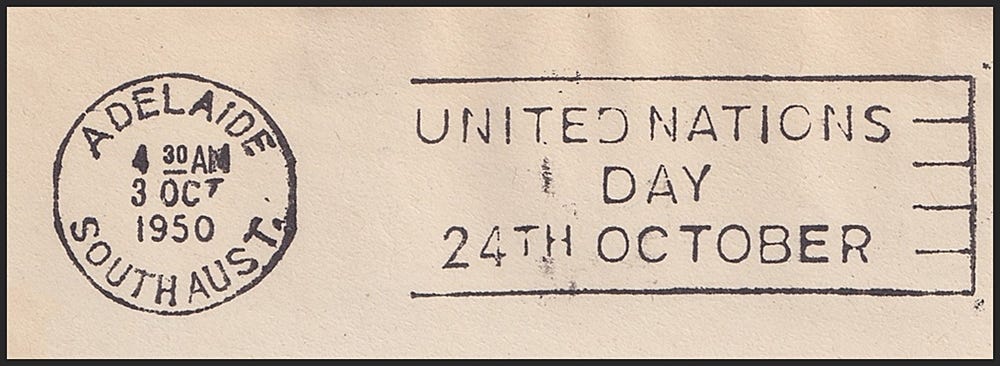
For two weeks, the postal slogan GIVE A DAY UNITED NATIONS APPEAL FOR CHILDREN carried this humanitarian message into Australian homes, businesses, and communities through the everyday circulation of mail. It also marked the beginning of a longer association between Australian postal messaging and the United Nations. The following year, the slogan UNITED NATIONS DAY 24TH OCTOBER was introduced, commemorating the anniversary of the United Nations’ founding in 1945 and promoting public awareness of its work and ideals. Appearing annually for one week each October until 1978, it reinforced the role of the postal service in communicating messages of international cooperation, humanitarian values, and global responsibility.
References
Appeal for children everywhere. (1948, June 28). Daily Mirror, p. 2. http://nla.gov.au/nla.news-article273457070
Children's fund £280,204 from all states. (1948, September 10). The Sydney Morning Herald, p. 3. http://nla.gov.au/nla.news-article18084311
Give a day's pay, and save a child. (1948, July 1). The Argus, p. 5. http://nla.gov.au/nla.news-article22687960
Occleshaw, R. C. (1989). Australian slogan cancellations 1917–1988: Volume 1: The commemorative and short term markings. Magpie Publications.
Occleshaw, R. C. (1991). Australian slogan cancellations 1917–1990: Volume 2: The definitive and long term markings. Magpie Publications.
U.N. children's appeal. (1948, November 29). The Advertiser, p. 3. http://nla.gov.au/nla.news-article43793326
United Nations appeal for children. (1948, June 25). Harvey-Murray Times, p. 8. http://nla.gov.au/nla.news-article251108041
U.N. appeal for children. (1948, August 25). Ovens and Murray Advertiser, p. 4. http://nla.gov.au/nla.news-article268195134
United Nations International Children’s Emergency Fund. (1948). The work of the United Nations International Children’s Emergency Fund: A statement of the origin, policies and future operations. UNICEF. https://www.unicef.org/documents/work-unicef
Slogan Shorts explores the social history hidden within Australia's postal slogans. Far more than a way of cancelling a stamp, these short messages captured the issues, ideas and everyday experiences that shaped Australian life. A postal slogan may only occupy a few centimetres on an envelope, but it can reveal a much larger story. In this series, we follow a slogan back to its origins, uncovering the people, events and changing priorities preserved in these small but fascinating documents of social history.
A bygone era where international efforts were idealistic, welcomed and supported by broad crosssection of society.
Thank you for taking the time to research and publish the backgrounds of these slogans. JeffS