

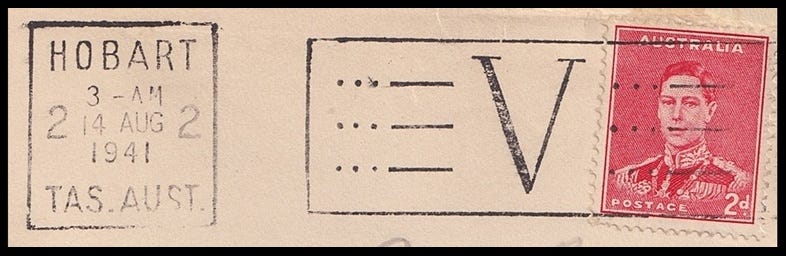
Every letter posted in wartime Australia carried the imprint of a nation at war. Censorship markings, military addresses, and other postal endorsements all reflected a society mobilised for conflict. Then, in August 1941, a new mark appeared on Australian mail. Dominated by a striking V, the new postal slogan transformed millions of ordinary letters into miniature ambassadors of the Allied campaign for victory.
The symbol formed part of an international campaign that spread rapidly throughout Britain and the Allied world during 1941. More than a simple emblem, the V for Victory sign became an instantly recognisable expression of resistance and confidence in ultimate Allied success. Its adoption by the Australian Post Office transformed an ordinary postal cancellation into an instrument of wartime propaganda, ensuring that each impression reinforced the message of unity, perseverance, and eventual victory.
On 4 August 1941, Melbourne became the first Australian city to use the new postal slogan featuring the distinctive V, flanked on either side by repeated representations of its Morse equivalent: three dots and a dash. The slogan was intended for use on Mondays, and the majority of surviving examples reflect this planned schedule. However, its application was not always so consistent. Examples in my collection dated Thursday 14 August (pictured above) and Friday 15 August 1941 demonstrate that the cancellation occasionally appeared on other weekdays, suggesting a degree of flexibility in its use.
The postal marking formed only one part of a much broader Post Office campaign. Postmaster-General Thomas Collins directed the department to give its full support to the movement. Eight-foot illuminated V signs were erected on General Post Offices across the country, victory posters appeared in post office displays, and the symbol was reproduced on telegram forms and postal stationery. Red, white, and blue V for Victory posters and cards were prepared for public display, while post office vans carried the slogan into communities across Australia.
The telephone network also joined the campaign. Manual exchange operators were instructed to answer calls with the greeting, “V for Victory, number please.” The idea captured the enthusiasm of the moment, but the practical demands of operating a busy telephone network soon became clear. The additional words slowed connections, and Director-General of Postal Services D. McVey cancelled the instruction after only a brief trial. The department continued to promote the campaign through other, less disruptive means.
The postal slogan itself also had a short life. By late November 1941, it had largely disappeared from Australian mail. In December, the Postmaster-General explained why. Letters sent to Australian prisoners of war held in Germany had been delayed, while others failed to reach their destination, because German authorities objected to patriotic slogans such as “V for Victory” and “Buy War Savings Certificates” appearing on envelopes. German authorities recognised the power of these words and feared their ability to sustain hope among the prisoners, encourage resistance, and undermine the narrative they sought to control within the camps.
The reaction was not unique to Australia. Reports from the United States noted that German authorities had also refused the delivery of letters to prisoners of war when envelopes carried victory slogans, including “V for Victory” and “Win the War.” In both cases, the slogans revealed the extent to which even postal markings had become part of the wider psychological conflict of the war. The battle for morale was being fought not only on the front lines, but also through the messages carried on the mail.
Then, in 1942, Australia suspended the use of slogan cancellations for the duration of the war. The V for Victory slogan had existed for only a few months, yet during that brief period it transformed the humble postal cancellation into a symbol of national purpose. It demonstrated that the home front was not separate from the conflict overseas: even a simple envelope could carry the language of resistance, reassurance, and resolve. In wartime Australia, the post was not merely delivering messages. It was helping to create them.
References
Join in the “V” campaign. (1941, July 29). The Tumut and Adelong Times, p. 2. National Library of Australia. http://nla.gov.au/nla.news-article138997845
Letters sent to prisoners delayed because of slogans. (1941, December 6). Sunraysia Daily, p. 5. National Library of Australia. http://nla.gov.au/nla.news-article269912942
Nazi post office bars V for Victory stamps. (1944, May 9). The Daily Telegraph, p. 1. National Library of Australia. http://nla.gov.au/nla.news-article248890170
Victory V greeting cancelled. (1941, July 29). Examiner, p. 4 (Late News Edition). National Library of Australia. http://nla.gov.au/nla.news-article52457915
Slogan Shorts explores the social history hidden within Australia's postal slogans. Far more than a way of cancelling a stamp, these short messages captured the issues, ideas and everyday experiences that shaped Australian life. A postal slogan may only occupy a few centimetres on an envelope, but it can reveal a much larger story. In this series, we follow a slogan back to its origins, uncovering the people, events and changing priorities preserved in these small but fascinating documents of social history.
I enjoy reading about the stories behind slogan cancels. JeffS
Argomento molto interessante. Complimenti!